
Duncan Atwood now balances coaching and business while remaining active in track and field.
Duncan Fuller Atwood, born on October 11, 1955, in Seattle, Washington, remains a notable figure in the track and field community.
Known for his achievements as a two-time U.S. Olympian and Pan American Games gold medalist in the javelin throw, Atwood has built a legacy that includes remarkable victories, challenges, and a lasting influence on the sport.
Duncan Atwood rose to prominence in the late 1970s and 1980s as one of the top American javelin throwers.
He won gold medals at the Pan American Games in 1979 and 1987 and represented the United States at the 1980 and 1984 Summer Olympics.
Atwood set his personal best of 78.92 meters in Rome in 1987, during the World Championships qualification round.
A three-time U.S. national champion, he was an All-American thrower at the University of Washington, where he earned his kinesiology degree.
Although the U.S. boycott kept him from competing in the 1980 Olympics, he received a Congressional Gold Medal for qualifying.
Atwood’s career faced a major setback in the early 1980s. During the 1983 Pan American Games in Caracas, he was one of several athletes who left after stricter drug testing was announced.
Two years later, in August 1985, he tested positive for a banned stimulant at a competition in Koblenz, Germany.
At the time, the International Association of Athletics Federations (IAAF) imposed a lifetime ban for first-time doping offenses.
Atwood’s ban was later reduced, allowing him to return to competition in 1987.
Despite the controversy, he came back to win another Pan American Games gold medal that same year—an achievement that highlighted both his resilience and his complicated legacy.
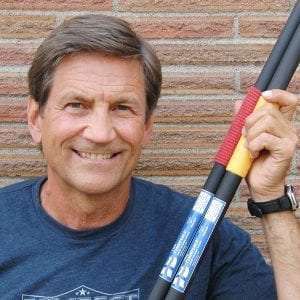
Today, Atwood channels his decades of experience into coaching.
Based in the Seattle–Tacoma area, he has served as an assistant javelin coach at Pacific Lutheran University since 2017, and has previously coached at Seattle Pacific University, Northwest University, and his alma mater, the University of Washington.
Although his name is no longer listed on PLU’s 2024–25 coaching staff, he continues to offer private coaching, e-coaching, and summer training camps for throwers nationwide.
In 2025, he appeared at major camps in Montana and Wyoming, demonstrating his ongoing involvement in the sport.
Beyond coaching, Atwood runs Finnflier, a business he founded in 2009 to import and distribute specialized Finnish training javelins.
Over the years, Finnflier has grown into a trusted brand in U.S. javelin training, used by schools and individual athletes alike.
Through the platform, he also provides e-coaching and biomechanics analysis, drawing from his decade of work with USA Track & Field High Performance.
His blend of technical knowledge and athletic experience makes him a sought-after mentor in the javelin community.
Atwood’s story is one of triumph, controversy, and reinvention.
His doping case remains a defining moment in his athletic history, but his ongoing commitment to coaching and innovation shows how he has continued to contribute to the sport.
As of 2025, Duncan Atwood lives in the Seattle area, staying active as a coach, entrepreneur, and mentor.
His journey—from Olympic hopeful to champion, from scandal to respected trainer—demonstrates how an athlete’s influence can endure long after their competitive days are over.

