
Former NFL quarterback Daunte Culpepper’s adoptive mother, Emma, took him into her home when he was just a day old.
Daunte Culpepper had a challenging start to life. He was born on January 28, 1977, in a Miami correctional facility, while his biological mother, Barbara Henderson, was serving time for armed robbery.
Unable to care for her newborn son, she made the difficult decision to give him up for adoption.
That’s when Emma Lewis Culpepper, a compassionate woman who worked at the facility, stepped in to change Daunte’s life forever.
Emma Culpepper, who lived in Ocala, Florida, took Daunte into her home when he was just one day old. At 62 years old, she was already a widow, having lost her husband, John Culpepper, in 1977, the same year Daunte was born.
Despite her age and the loss of her husband, Emma opened her heart to Daunte.
In fact, Emma was no stranger to caring for children. She and John had adopted as many as 15 children. Above all, Emma’s mission was to help others, and she lived that mission every day.
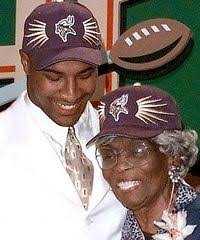
In an interview with The Associated Press in 2007, Daunte praised Emma, saying:
She was basically just on a mission always to help people. Anybody that touched her life, she was always trying to better them.
Daunte Culpepper
Emma crossed paths with Daunte’s biological mother, Barbara Henderson, at her workplace at the youth delinquency school in Ocala.
When Henderson gave birth to Daunte in prison, Emma, who worked at the youth delinquency school where Henderson was held, adopted him the very next day.
Despite being raised by his adoptive parents, Daunte has a sound relationship with his biological parents.
Years later, Daunte spoke warmly of his biological mother, saying she had turned her life around. She noted that his mother, Barbara, was living in Miami, married with five other children.
He gave a sneak peek of their sound relationship, saying, “She’s turned her life around. We have a great relationship now.”
Daunte described Emma as both a mother and a father to him. She basically filled the gap left by the absence of a father figure. Daunte reflected on Emma’s decision to adopt him, saying:
It was the best thing that happened to me in my whole life. I never really had a man in my life. She was my mother and my father.
Daunte
Daunte Culpepper’s Adoptive Parents Never Had Children of Their Own!
Emma was born in 1914 on the outskirts of Ocala. She was known to many as “Miss Emma” or “Aunt Dolly.”
She and her husband, John, never had biological children of their own. Instead, they opened their home to raise the children of relatives or others in need.
In fact, they were so committed to caring for other children that they didn’t really think of having their own.
Emma revealed insights about their thoughts on having a child in the Star-Banner in 2001:
Every time we said, ‘Let’s have a baby,’ they’d hand us another child. We didn’t have time to have one of our own. I walked away from my own to help someone else, but I’m glad I did.
Emma
Emma was strict yet caring, always ready to guide with discipline when necessary. Daunte spoke of his upbringing, noting the strong principles Emma taught him, saying:
She always told me to treat people like you want to be treated and to be the best you can be.
Daunte
She raised me the old school way … with good common sense values, and that is how I’m raising my children today.
Daunte never forgot the woman who gave him a home and a future.
When he became a professional football player, one of the first things he did was buy Emma a five-bedroom house in Westbury, off Shady Road in Ocala.
Emma told the Star-Banner in 2001, saying:
All I know is, Daunte gave me the keys and said, ‘Here’s your house. He picked it out himself. It’s comfortable here now. I didn’t ever think I’d have what I have here.
Emma
Emma Culpepper passed away on Saturday, May 5, 2007, at her home in Ocala at the age of 92. The exact cause of death wasn’t immediately known, but Daunte noted that she had been suffering from Alzheimer’s disease in her later years.
She was an angel, not only to me but to everyone she came in contact with,” Daunte said, reflecting on her impact. “If not for her, I don’t know where I’d be.”
Daunte Culpepper

