
In competitive gymnastics, fostering an inclusive environment for athletes with autism, ADHD, and sensory processing disorder (SPD) poses both challenges and opportunities.
Gymnastics is a sport of grace, strength, and determination.
Still, for some athletes, like a young girl with autism, ADHD, and sensory processing disorder (SPD), it can also be a world of overwhelming sensations and rigid rules.
A heartfelt post shared anonymously in the “Autism Parents Support Group” on Facebook brought this reality into sharp focus.
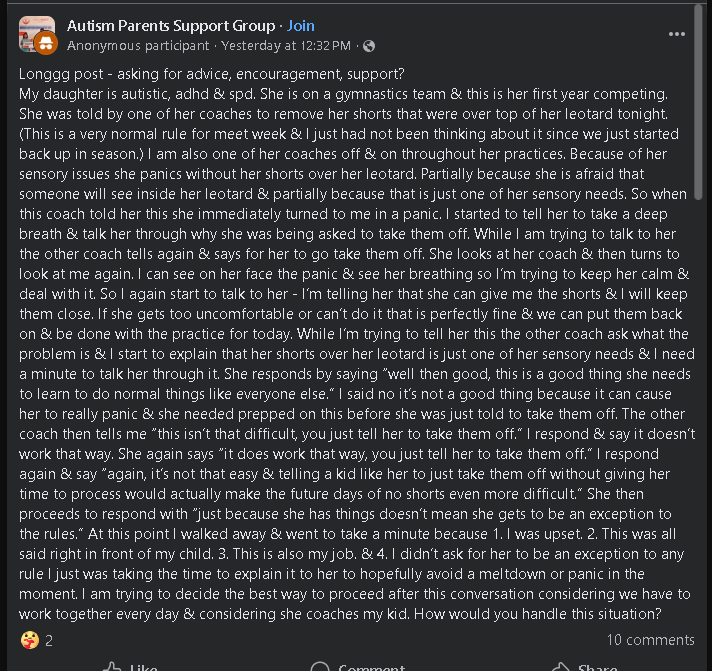
The parent, who also coaches part-time at their daughter’s gym, shared a painful moment when their daughter was told to remove her sensory shorts, her lifeline for feeling comfortable and secure during a practice session.
The incident, coupled with a coach’s dismissive attitude, left the parent facing frustration and a desire to advocate for their daughter.
This story isn’t just about one gymnast; it’s a call for all of us to make sports a more welcoming place for autistic athletes.
A Tough Moment at Practice
The young gymnast was new to the competitive team, already facing a big leap into the high-pressure world of gymnastics.
To manage her sensory sensitivities, she wore shorts over her leotard, a simple accommodation that helped her feel grounded.
However, during a meet-week practice, a gym rule took effect: athletes were required to wear only their competition leotards, with no extra clothing allowed.
The parent, understanding their daughter’s needs, tried to ease her through this change, explaining the rule gently to avoid a meltdown.
Then another coach stepped in, repeatedly demanding the girl “just take them off” and brushing off her sensory needs with comments like, “she needs to learn to do normal things” and “she doesn’t get to be an exception.”
“It was crushing to hear her needs dismissed right in front of her. I had to step away to keep my cool.”
Via Facebook
The conversation happened in front of the girl, adding to the parents’ distress. As both a mom and a colleague, they felt torn, angry at the lack of empathy, but needed to stay professional.
Later, in a follow-up comment, they shared,
“Thank you to everyone who took the time to read all of this & respond. It helps me feel a lot more validated in my feelings while I try to decide how to best handle the situation & advocate for her.”
Via Facebook
The online community rallied around them, offering support and ideas to move forward.
For kids with autism or SPD, sensory tools like wearing extra shorts can make all the difference.
Tight leotards, bright lights, or the feel of exposed skin can be overwhelming, sometimes even painful.
Those shorts weren’t just clothing; they were a way for this gymnast to stay calm and focus on her routines.
Forcing her to remove them without warning risked pushing her into sensory overload, which can lead to a meltdown that’s not a tantrum but a real, physical response to distress.
Gymnastics, with its strict uniform rules, can feel like a minefield for autistic athletes.
However, as Kathryn Hancock Kashner, a former gymnast, pointed out in the comments, national competitions often allow more coverage, such as unitards, for cultural or religious reasons.
Kathryn Hancock Kashner wrote:
“If national competitions allow fuller coverage, why can’t local gyms? What if a gymnast’s faith required less skin showing?”
Via Facebook
The Facebook group’s responses were full of compassion and practical advice.
Jenny Legg suggested slipping neurodiversity training materials into the coach’s bag and pushing for team-wide education at coaching meetings.
She noted that learning how people process words differently, some through sound, others through visuals, could help coaches connect with every athlete, not just those with autism.
She also had a tip for handling tense moments: keep it short and firm, like, “Avoiding a meltdown, she’ll be ready in five, I’m handling it.”
Jenny Legg wrote-:
“Neurodiversity training could change how coaches work with everyone. Communication is everything in sports.”
Via Facebook
Katherine Abrams was more blunt, saying some coaches just aren’t cut out to work with autistic kids, especially in hardcore gyms where the focus is on performance, not people.
She urged the parent to talk with the coach, but also to consider if the program was right for their daughter.
Stephanie Holt offered a way to build empathy: ask the coach to imagine something that stresses them out and picture someone belittling their way of coping.
Stephanie Holt wrote-:
“Everyone has something that makes them panic. Just because it’s not an issue for the coach doesn’t mean it’s not real for your child.”
Via Facebook
These ideas present a clear path forward: coaches require better training, and gyms must prioritize inclusion. It’s not about special treatment—it’s about giving every kid a fair shot to succeed.
This story is a wake-up call. Gymnastics should be a place where every kid feels safe to grow, not a battleground of rigid rules and misunderstandings.
For autistic gymnasts, small changes, such as keeping their sensory shorts or getting a little extra time to adjust, can open the door to success.
The parents’ commitment to advocating for their daughter, backed by a supportive community, shows what’s possible when we work together.
Anonymous Parent wrote-:
“Every kid deserves to feel supported in sports. Inclusion means listening and making room for everyone.”
Via Facebook
By embracing empathy, training, and flexibility, gyms can become places where autistic athletes don’t just compete, they soar.

