
Growing up in a so-called safe haven designed for deaf students, Tarl Fields shares the heartbreaking reality of feeling lost and unprepared for the world in a powerful Facebook post on the page Deaf Dystopia.
Tarl, a former student at the Texas School for the Deaf (TSD) in Austin, Texas, opened up about his experiences from around 1985 to 2001.
He graduated in 2001, but looking back, he realized how much the school fell short. After posting a vlog about his life, people reached out to him, sharing similar stories.
This flood of messages hit him hard and made him show deep concern for the teachers and the system at TSD during those years.
Tarl described a mixed bag of teachers at TSD. Some were amazing and truly made a difference.
For example, his first-grade teacher, Carilynne Gay, stood out as a shining star. She was patient, encouraging, and turned learning into something exciting.
He still remembers how she taught the days of the week, built vocabulary, handled reading and math lessons, and even used fun magazines like Starline to keep things engaging. But things took a sharp turn starting in second grade.
From there on, many teachers were either sweet but ineffective, or downright cruel. Some misused discipline systems in ways that hurt more than help.
Tarl recalled one teacher who gave him “frown faces” on a behavior chart every hour, not because of bad behavior, but simply because he pushed back or asked questions.
This made others see him as a “bad kid” all day, even though that wasn’t the truth. Systems like this didn’t build students up. Instead, they taught fear, shame, and a reluctance to seek help.
The core problem, according to Tarl, was that TSD didn’t provide a real education. It failed to teach essential skills like discipline, homework habits, meeting deadlines, or taking responsibility.
Classes were often a joke. Math lessons boiled down to mindlessly copying from books without any real understanding.
History class dragged on with almost nothing covered all year. One teacher, who was part of the Kappa Gamma fraternity from Gallaudet University, retired after doing the bare minimum. And then there was PE teacher Andy Bonheyo, known for his sign name related to Kappa Gamma.
He taught four years of classes that amounted to nothing but weightlifting.
There was no education on sports strategies, no vocabulary building around physical activities, and zero focus on health knowledge. This kind of teaching left students without the foundations they needed.
Tarl pointed out that many teachers had degrees, especially from Gallaudet, the renowned university for the deaf. But a degree didn’t mean they could teach effectively.
Important topics were completely missing from the curriculum. Students never learned about Deaf history, the basics of American Sign Language (ASL) as a structured language, or world history.
Key events like the Milan Conference of 1880, which had a massive impact on Deaf education by promoting oralism over sign language, were never mentioned.
This gap left graduates like Tarl walking into the hearing world feeling unprepared, embarrassed, and confused. He had to figure out so much on his own after leaving school.
His hearing family couldn’t bridge the gap in Deaf education, and TSD was supposed to be the place that did. But it didn’t.
Favoritism ran rampant at TSD, and Tarl called it out as a major harm to students. Certain kids or staff got special treatment, while others were overlooked or punished unfairly.
Unqualified teachers stayed on without any accountability. Even in science classes, inconsistency was the norm.
Two teachers might teach completely different information on the same topic. If a student noticed an error and spoke up, the teacher would protect their ego instead of admitting the mistake.
They might even punish the student for pointing it out. This environment didn’t foster learning. It broke spirits and built barriers.
Tarl’s post connected with others and sparked a lively discussion in the comments.
DaMich Philly suggested that maybe Tarl could leave Texas for a fresh start in another state with better opportunities, new people, and new experiences.
He argued that staying in the same place for years without progress is a waste of time. He also defended Gallaudet, saying it wasn’t the university’s fault.
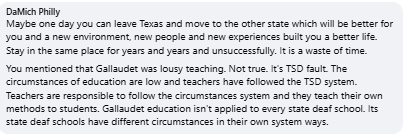
Instead, he blamed TSD’s low standards and its own system. Teachers had to follow the school’s rules, but they brought their own methods, and Gallaudet’s education didn’t apply uniformly to every state deaf school.
Barbara Dodd highlighted how teachers focused too much on behavior, which blocked students from actually learning.
You see that? Teachers focused on his behavior, thereby preventing him from learning; his right to education was denied based on the teacher’s beliefs and bad faith. Now he remembers his childhood, who was good or who hurt him.
Via Facebook
Alan McCall pushed back, saying most of the time, it’s the parents’ fault, not the school’s.
“Most time its parents fault. No one else. Quit blaming at schools. Kids parents there now didn’t act anything so it is out of order for anyone to post it.”
Via Facebook
Alec McFarlance praised Tarl’s vlog and expanded the issue beyond just teachers or TSD.
He described it as part of a larger system in the Deaf community, filled with status quo, privilege, and elitism.
Elites dictate things for their own benefit, and this shows up in Deaf nonprofits, civil rights groups, and more.
He mentioned how the National Association of the Deaf (NAD) often votes “education” as a top priority at conferences, yet problems persist. Tarl was right, he said—this self-glorification and focus on status is hurting the community deeply.
Becky Craig Fields, Tarl’s mom, chimed in with pride for her son, speaking his mind.
She admitted she might not have been the best mom, as she was slow to learn sign language, but she tried. She didn’t know about his school struggles at the time.
If he had told her, she’s not sure she would have listened fully; that’s her honest take.
She loves him dearly, calls him the best, and has always encouraged him to achieve what he sets his mind to.
Since leaving school, he’s proven that. She ended with more love and a promise to talk later.
Charles Muri May defended TSD, saying it has a good education overall. He suggested Tarl’s experiences were just his personal ones, where he was treated wrong by others.
He called Tarl his brother and encouraged him to stay strong.
This story isn’t isolated. From what I’ve gathered, similar criticisms of favoritism and poor teaching at TSD echo in online discussions within the Deaf community.
For instance, on platforms like Facebook’s Deaf Dystopia, former students have shared how bias was obvious, with some teachers showing clear preferences that divided classrooms and left many feeling undervalued.
Andy Bonheyo’s name comes up in these talks as an example of how PE classes lacked substance, focusing on repetitive activities without broader lessons, which ties into the bigger issue of favoritism, where certain students got more attention or leniency, while others were sidelined.
This pattern, from the 1980s to the early 2000s, highlights a need for reform.
TSD has made some changes since then, like updating curricula to include more Deaf studies and ASL linguistics, but alumni like Tarl remind us that accountability is key.
Favoritism erodes trust, and without addressing it, schools can’t truly build strong Deaf minds.
Tarl’s call for better teachers, fair systems, higher expectations, and real care still rings true today. It’s a push for TSD to stop breaking students and start empowering them.

